
Fixing a picture rail to brick, concrete, gypsum or wood
The JAM aluminium rail can be fixed to brick and RCC walls, gypsum board partitions and wood panelling. The rail is the same on every surface; the fixing is what changes. Here is a practical approach for each wall type found in Indian homes and offices, what to check before you drill, and how the load ratings work with your fixings.
By Window Techs India Pvt Ltd · Updated
Which walls can a picture rail be fixed to?
The rail is fixed once, along the top of the wall, and everything after that is tool-free: the Cobra end of each cord clips into the rail channel and the hooks set the height. So the only part of the job that depends on your wall is that one line of fixings.
- Brick and RCC (concrete): most Indian homes and many offices. Drill with a masonry bit and use wall plugs.
- Gypsum board partitions: common in offices, shops and newer apartments. Fix into the metal studs or channels where you can.
- Wood panelling and plywood: screw directly, into the battens behind for heavier loads.
- False ceilings (POP or gypsum): covered in its own guide, fixing a picture rail under a false ceiling.
If your walls are AAC or hollow concrete blocks, which are common in newer buildings, or you are not sure what is behind the plaster, ask a local installer or ask us before you order fixings.
How to fix a picture rail to a brick or concrete wall
Brick and RCC walls give the strongest fixing, as long as the screw is held by the structure. Most Indian walls have cement plaster, wall putty and paint on top, a thin finish over the brick or concrete. A plug that sits only in plaster and putty can pull out under load, so choose plugs long enough to grip the masonry behind.
- Drill with a masonry bit in hammer mode, at a diameter matched to the plug. Use plugs sized to the screw, so the screw expands the plug firmly without splitting it.
- Brick: drill into the brick itself rather than a mortar joint where you can; plugs hold better in solid brick.
- RCC: concrete is harder and slower to drill. If the bit stops dead, you may have hit reinforcement steel. Stop, move the hole slightly along the line and drill again rather than forcing it.
- Hollow-sounding plaster: tap the wall along the line. A hollow sound can mean the plaster has separated from the wall, and a fixing there is weaker. Move the fixing to a solid spot or have the plaster repaired first.
- Clean the hole of dust before inserting the plug, then screw the rail through its holes into the plugs, checking level as you go.
Can a picture rail go on gypsum board or drywall?
Yes. Gypsum board (drywall) partitions are a board skin over a frame of metal studs and channels. The board alone is soft and holds less than masonry, so the frame is where the strength is.
- Find the studs. Use a stud detector, a strong magnet that finds the screw heads, or the partition drawings. Mark each stud along the rail line.
- Fix into the studs or the top channel where possible, using screws suited to metal framing.
- Between studs, use anchors made for gypsum board (cavity or board anchors), not ordinary masonry plugs, which do not grip in board.
- Keep heavy pieces on fixings into studs. Hang mirrors, large canvases and anything on Zipper hooks on the stretch of rail that is screwed into the frame.
Fixing a picture rail to wood panelling or plywood
Wood panelling, plywood and laminate-faced boards are the simplest surface: screw the rail directly with wood screws, no plugs needed. Drill a small pilot hole first so the panel does not split, particularly near edges.
Panelling is usually fixed over battens. For heavy loads, find the battens and screw through the panel into them. Treat thin veneer or decorative panels like board: fix into what is behind them.
What to check before you drill
This matters more than the fixing itself. In many Indian buildings, wiring runs in concealed PVC conduits through the walls and across the top of the wall to light and AC points, which is exactly where a picture rail goes.
- Electrical conduits: they often run straight up from switchboards and sockets and across to light points. Avoid drilling directly above switches and sockets, and use a cable and pipe detector along the whole line.
- Water pipes: walls next to bathrooms and kitchens, and walls with taps or geysers on the other side, may carry concealed pipes.
- AC lines: split AC copper pipes and drain pipes are often concealed in the wall between the indoor and outdoor units.
- Damp patches: damp or flaking plaster, often below bathrooms or on external walls after the monsoon, holds plugs poorly. Fix the cause first.
- Drawings: check electrical and plumbing drawings if you have them, or ask the building's electrician.
If you hit something unexpected while drilling, stop. Turn off the power to that circuit if there is any chance it is a cable, and get it checked before you continue.
Finding the line for the rail
The rail normally runs just below the ceiling, or just below the cornice or moulding if the room has one, so it reads as part of the ceiling edge.
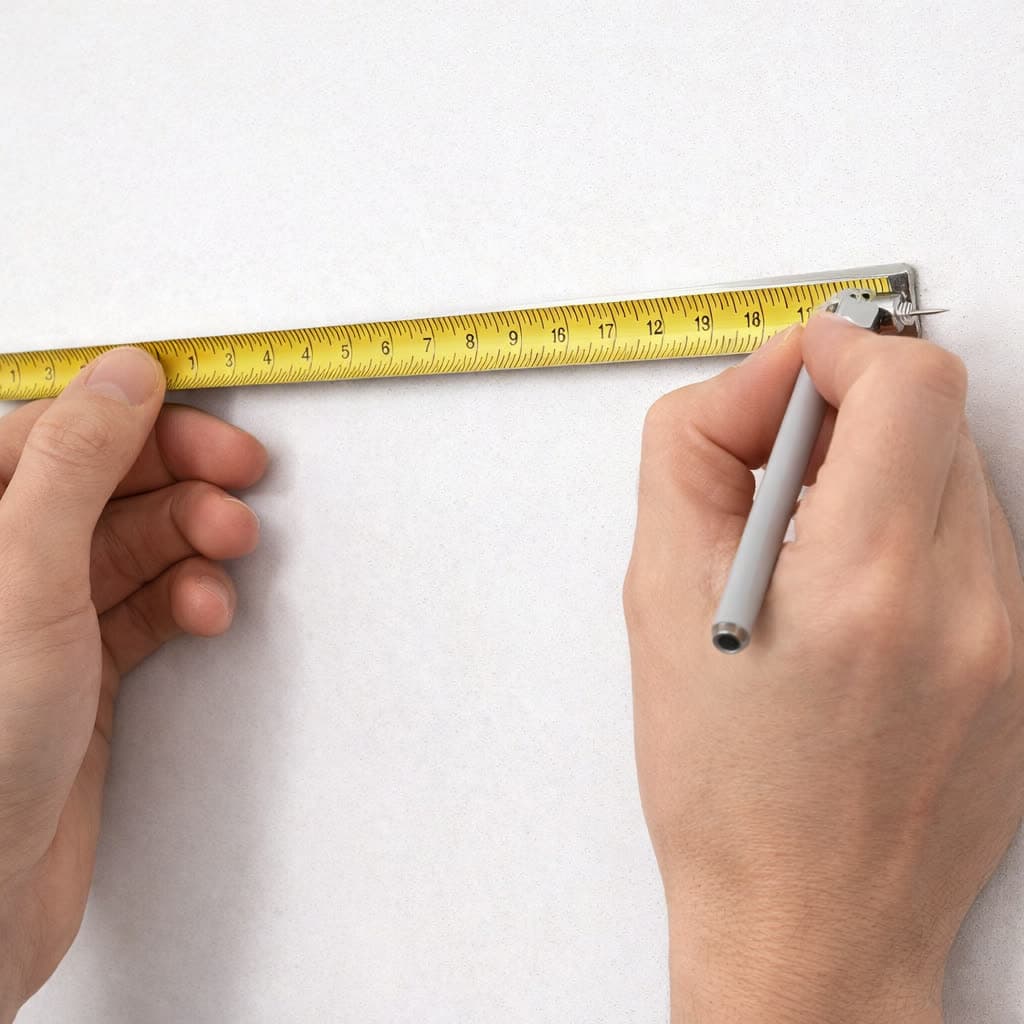
- Measure down from the ceiling at both ends of the wall and in the middle. Ceilings are not always level, so note the differences.
- Draw a level line with a spirit level or laser level at the height you choose, close under the lowest point of the ceiling.
- Mark each fixing point along that line, then run the cable and pipe check along it again.
If the ceiling slopes noticeably, choose between a true level rail and one that follows the ceiling. The cords hang straight down either way, and each frame is levelled by its hooks.
How far apart should the fixings be?
Fix the rail at regular intervals along its whole length and near each end, so no stretch of rail is left unsupported. Use more fixings, closer together, where you will hang heavy pieces, and on softer surfaces such as gypsum board.
Follow the fixing maker's rating for your wall and screw size, and choose fixings rated for the load you plan to hang, with a margin. Where two pieces of rail meet end to end, put a fixing near each end. If you are not sure what spacing suits your wall, ask us or a local installer.
How much weight can a wall-mounted rail hold?
The aluminium rail is rated 25 kg per metre, spread along it. Each Perlon cord is rated 20 kg, the standard hook 4 kg and the Zipper hook 15 kg. Two cords and two hooks per artwork is typical.
The lowest rating in the chain is the limit, and the fixing's own rating applies too. A rail rated 25 kg per metre on fixings that hold less in your wall can only carry what the fixings hold. These are stated capacities, not laboratory certificates. Weigh heavy pieces, and see what 25 kg per metre means for worked examples.
Summary: fixing by wall type
| Surface | Fixing approach | Tips |
|---|---|---|
| Brick | Masonry bit, wall plugs sized to the screw | Drill into brick, not mortar; plug must reach past plaster and putty |
| RCC (concrete) | Masonry bit in hammer mode, wall plugs | If the bit stops dead on steel, move the hole slightly |
| Gypsum board | Screws into metal studs or channels; board anchors between them | Keep heavy pieces on the stretch fixed into studs |
| Wood panelling or ply | Wood screws directly, with a pilot hole | Screw into the battens behind for heavy loads |
| False ceiling | Into the framing or slab above, not the board | See the false ceiling guide |
Fitting out several walls or a whole office? The project estimator builds one bill of materials, and for large commercial projects we can arrange professional installation.
Questions
Can a picture rail be fixed to a brick wall?
Yes. Drill into the brick with a masonry bit and use wall plugs sized to the screw, long enough to grip the brick behind the plaster and putty.
Can I fix a picture rail to an RCC concrete wall?
Yes. Use a masonry bit in hammer mode and wall plugs. If the bit stops on reinforcement steel, move the hole slightly along the line rather than forcing it.
Will a picture rail hold on gypsum board?
Yes, when it is fixed into the metal studs or channels where possible, with anchors made for gypsum board in between. Keep heavy pieces on the stretch of rail fixed into studs.
How many fixings does the rail need?
Fix it at regular intervals along its length and near each end, with more fixings for heavy loads or softer walls. Follow the fixing maker's rating for your wall, or ask us or a local installer.
Which tools do I need?
A drill, fixings suited to your wall, a level and a cable and pipe detector. You drill once to fix the rail; cords and hooks go on without tools.
Do the load ratings depend on my wall?
Yes. The rail is rated 25 kg per metre, cords 20 kg and hooks 4 kg or 15 kg, and the fixing's own rating in your wall also applies. The lowest of these is the limit.
Ready to hang it?
One wall: build the system in three steps. Several walls or sites: estimate the project and get a GST quote.